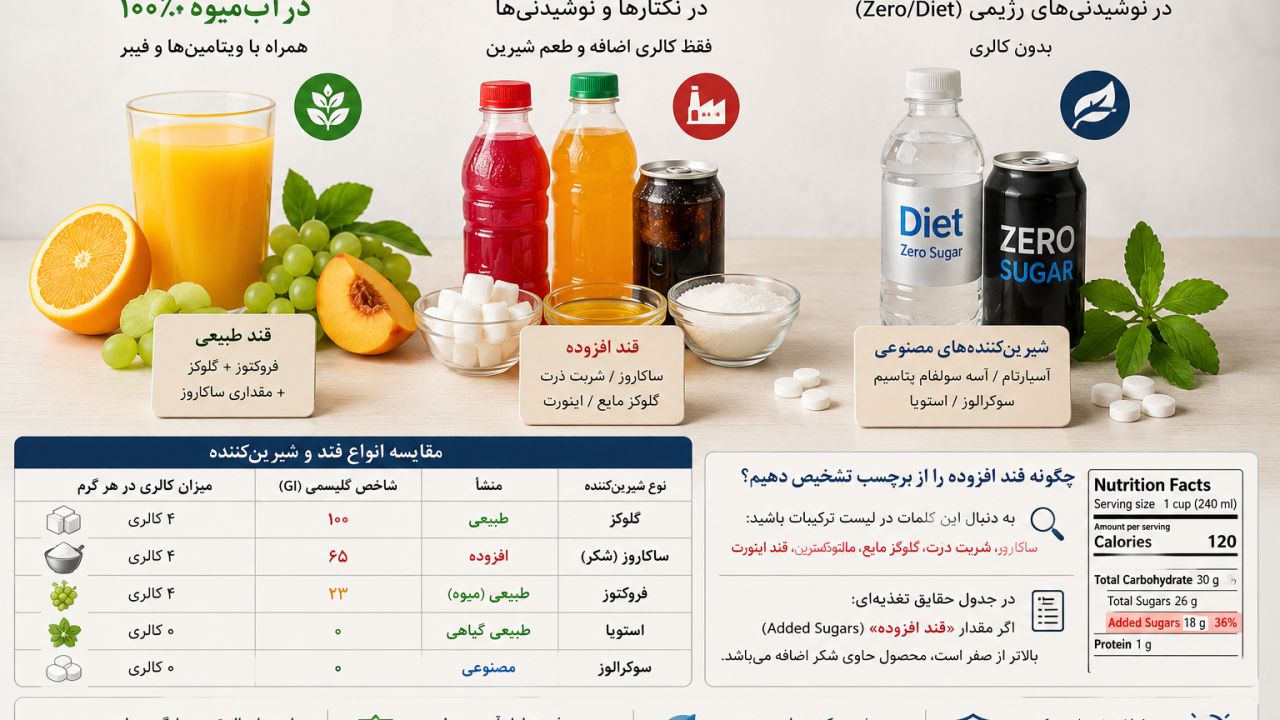
Sugars in fruit-based beverages can be broadly classified into two categories: naturally occurring sugars inherent to the fruit (primarily fructose and glucose), and added industrial sugars (such as sucrose or corn syrup). While natural sugars are present in 100% fruit juices alongside vitamins, minerals, and dietary fiber, added sugars in nectars and fruit drinks contribute primarily to increased caloric content and sweetness. In reduced-calorie or diet products, sugar is typically replaced with non-caloric artificial sweeteners.
Understanding the type of sweetener consumed is critical for effective metabolic health management. Differences in absorption rates of these sugars into the bloodstream directly influence insulin response and fat storage mechanisms. In this article, we examine the fundamental distinctions between natural sugars, added sugars, and artificial substitutes, focusing on their chemical structures and biological effects.
What Is the Difference Between Natural Fruit Sugars and Added Industrial Sugars?
The primary distinction lies in both chemical composition and nutritional context. In natural fruit juice, sweetness is derived from fructose, glucose, and small amounts of sucrose, all inherently present within the fruit matrix. In contrast, fruit nectars and beverages often contain added sweeteners such as refined sucrose (table sugar) or invert sugar (a hydrolyzed mixture of glucose and fructose) to achieve a desired flavor profile.
A critical consideration is that the human body metabolizes 100% fruit juice differently from sugar solutions due to the presence of phytonutrients. However, from a caloric standpoint, added sugars can significantly elevate the glycemic load of a product.
Why Does Fructose Metabolism Differ from Glucose in the Body?
Unlike glucose, which is utilized by nearly all body cells as an energy source, fructose is predominantly metabolized in the liver. Excessive intake of fructose—particularly from industrial beverages sweetened with high-fructose corn syrup—can overwhelm hepatic metabolic capacity, leading to increased triglyceride production and potentially contributing to non-alcoholic fatty liver disease (NAFLD). Therefore, moderation is essential, even when consuming natural fruit juices.
Common Artificial Sweeteners Used in Diet Beverages
In “Zero” or “Diet” beverages, sugar is replaced with high-intensity artificial sweeteners. The most commonly used include aspartame, acesulfame potassium (Ace-K), and sucralose. These compounds are hundreds of times sweeter than sucrose, meaning only little quantities are required to achieve the desired sweetness, effectively reducing caloric content to near zero.
To mitigate potential aftertastes (such as bitterness), manufacturers often use blends of multiple sweeteners. While these compounds are approved by food safety authorities, ongoing scientific discussions continue regarding their potential effects on gut microbiota and appetite regulation.
Are Aspartame and Sucralose Safe for Long-Term Consumption?
International regulatory bodies such as the WHO and FDA have deemed these sweeteners safe within established Acceptable Daily Intake (ADI) limits. However, some studies suggest that prolonged consumption may influence insulin sensitivity. From a technological perspective, sucralose is more heat-stable than aspartame, making it more suitable for pasteurized beverage applications and thus more widely used in industrial production.
The Role of Stevia as a Natural Zero-Calorie Sweetener
Stevia represents a significant innovation in natural sweetening solutions. Extracted from the leaves of Stevia rebaudiana, it contains steviol glycosides that are up to 300 times sweeter than sugar, yet do not impact blood glucose levels. This makes stevia an ideal option for beverages targeted at diabetic consumers.
Due to its plant-based origin, stevia aligns well with “clean label” trends and has gained strong consumer acceptance in diet formulations. However, it may impart a slight licorice-like aftertaste, which manufacturers address through advanced purification and filtration technologies.
How to Identify Added Sugars on Product Labels
The most reliable approach is to examine the nutrition facts panel, specifically distinguishing between “Total Carbohydrates” and “Added Sugars.” Sugars derived directly from fruit are categorized as natural sugars. However, the presence of ingredients such as sucrose, corn syrup, liquid glucose, or maltodextrin indicates added sugar content.
In industrial quality control, refractometers are used to measure soluble solids via the Brix scale. If a product’s Brix value significantly exceeds the standard range for the corresponding fruit, it may indicate the addition of sugars beyond the natural formulation.
How Do Different Sugars and Sweeteners Affect the Glycemic Index (GI)?
The Glycemic Index (GI) reflects the rate at which carbohydrates are converted into glucose in the bloodstream. Pure glucose has a GI of 100, whereas naturally occurring fructose in fruit has a significantly lower GI (approximately 19–23). Table sugar (sucrose), with a GI of around 65, falls into the moderate category. Artificial sweeteners and stevia, by contrast, have a GI of 0.
Consumption of high-GI beverages triggers rapid insulin secretion, which over time may increase the risk of type 2 diabetes. The presence of dietary fiber (pulp) in beverages can help moderate this response and improve the overall glycemic profile. For further insights on the functional role of fiber, refer to our dedicated article on the benefits of fruit pulp in industrial beverages.
|
Sweetener Type |
Origin |
Glycemic Index (GI) |
Calories per Gram |
|
Glucose |
Natural |
100 |
4 kcal |
|
Sucrose |
Added |
65 |
4 kcal |
|
Fructose |
Natural (fruit) |
23 |
4 kcal |
|
Stevia |
Natural (plant) |
0 |
0 kcal |
|
Sucralose |
Artificial |
0 |
0 kcal |
Are “No Added Sugar” Beverages Truly Effective for Weight Loss?
The claim “No Added Sugar” indicates that no additional sugars have been incorporated during production; however, this does not imply that the product is calorie-free. Naturally occurring sugars present in fruit concentrates still contribute calories, and excessive consumption may hinder weight loss efforts.
In contrast, beverages formulated with artificial sweeteners (commonly labeled as “Sugar-Free”) contain negligible or zero calories. Nevertheless, some studies suggest that regular consumption of such sweeteners may condition the palate toward heightened sweetness, potentially increasing cravings for carbohydrates in other meals. Therefore, the most effective strategy for weight management involves moderate consumption of natural fruit juices with higher fiber content and controlled portion sizes.
Conclusion
Choosing between natural fruit sugars and artificial sweeteners ultimately involves balancing nutritional intake with calorie management. While 100% natural fruit juice contains intrinsic sugars, it also provides essential micronutrients and bioactive compounds. On the other hand, artificial sweeteners serve as effective tools for glycemic control in diabetic people or those pursuing aggressive calorie reduction.
Consumers are strongly advised to review ingredient lists carefully to identify hidden sugars. Among zero-calorie sweetening options, stevia stands out as the most favorable natural alternative.
FAQ – Frequently Asked Questions about Sugars and Sweeteners
- Does sugar in 100% natural fruit juice cause diabetes?
Moderate consumption is generally safe; however, due to its faster absorption compared to whole fruit, excessive intake should be avoided. - Which artificial sweetener is more suitable for cooking and processing?
Sucralose is more heat-stable than aspartame, making it better suited for thermal processing and cooking applications. - What is the difference between invert sugar and regular sugar?
Invert sugar is a mixture of glucose and fructose with higher sweetness intensity and improved stability, helping prevent crystallization in products like nectars during storage. - Does stevia have an unpleasant taste?
Some consumers may detect a slight bitter or licorice-like aftertaste; however, this is typically masked effectively when blended with fruit flavors. - Why are some beverages labeled “suitable for diabetics”?
Because they utilize low- or zero-GI sweeteners such as artificial sweeteners or stevia instead of high-GI sugars. - Can children consume artificial sweeteners?
It is generally recommended that children rely on natural sources of sugar to avoid developing a preference for excessively sweet tastes. - Is fructose in fruit different from fructose in corn syrup?
Chemically, they are identical; however, in whole fruit, fructose is accompanied by fiber and vitamins that modulate its absorption and metabolic impact. - Why are some natural fruit juices very sweet?
This depends on the fruit type and its Brix level; fruits such as grapes naturally contain high sugar concentrations. - Is maltodextrin considered a sugar?
It is a complex carbohydrate used primarily as a bulking agent, but it has a very high glycemic index. - How can cravings for sugary beverages be controlled?
Gradually incorporating pulp-containing juices and beverages sweetened with stevia can help reduce dependence on refined sugar.